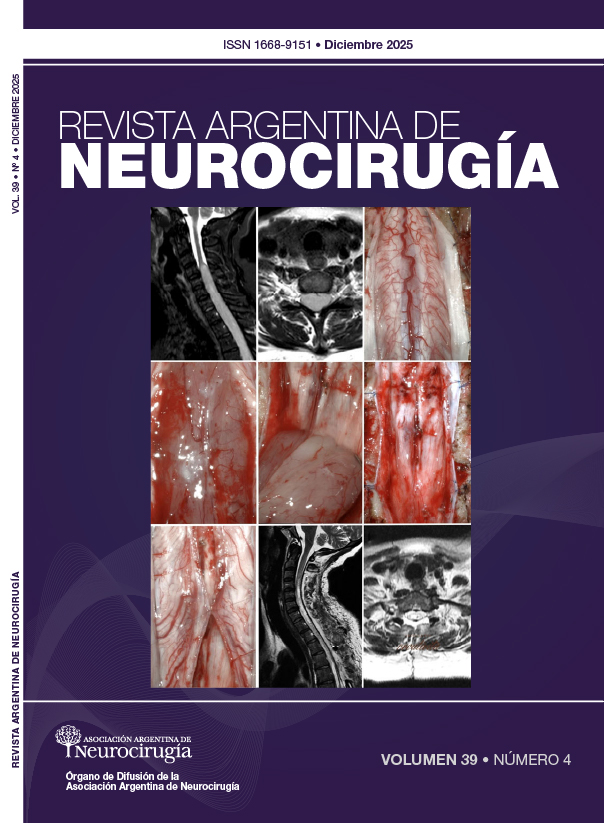
Use of the semi-sitting position in the resection of cervical spinal tumors. Surgical technique and presentation of illustrative casesgical technique and presentation of illustrative cases.
DOI:
https://doi.org/10.59156/revista.v39i04.786Keywords:
Air embolism, Cervical spine, Semisitting position, Spinal tumorAbstract
Background: spinal tumors account for approximately 15% of all tumors of the central nervous system. Patient positioning on the operating table is a critical step in spinal surgery, with the prone position being the most used. The semisitting position offers several advantages; however, it has been associated with devastating complications, leading to its restricted use or abandonment in many centers. Consequently, there are limited reports regarding its application in cervical spine surgery.
Objectives: to describe step by step the surgical technique for the resection of cervical spinal tumors using the semisitting position and to present an illustrative case series.
Methods: a total of 37 cases of cervical spinal tumors were surgically treated in the semisitting position between January 2015 and May 2025 at 2 different centers. Demographic data, preoperative radiological studies, tumor location, preoperative Karnofsky Performance Status, histological subtype, extent of resection, postoperative Karnofsky score, and morbidity and mortality were analyzed.
Results: among patients with spinal tumors operated on in the semisitting position (n = 37), 21 were female (57%) and 16 male (43%), with a mean age of 48.8 years (range: 25–71). The most frequent location was intradural-intramedullary (49%), and the predominant histological subtype was ependymoma. Pain was the most reported presenting symptom. Gross total resection was achieved in 6/8 (75%) extradural tumors, 8/11 (72%) intradural-extramedullary tumors, and 15/18 (83%) intradural-intramedullary tumors. No perioperative complications related to patient positioning were observed in any case.
Conclusion: the semisitting position for the resection of spinal tumors may be considered a valid alternative for achieving adequate tumor resection.
Downloads
References
1. Kumar N, Tan WLB, Wei W, Vellayappan B. An overview of the tumors affecting the spine-inside to out. Neuro Oncol Pract. 2020;7(1):10-7. Doi:10.1093/nop/npaa049 DOI: https://doi.org/10.1093/nop/npaa049
2. Kotecha R, Mehta MP, Chang EL, Brown PD, Suh JH, Lo SS, y col. Updates in the management of intradural spinal cord tumors: a radiation oncology focus. Neuro Oncol. 2019;21(6):707-18. Doi: 10.1093/neuonc/noz014 DOI: https://doi.org/10.1093/neuonc/noz014
3. Arnautovic K, Arnautovic A. Extramedullary intradural spinal tumors: a review of modern diagnostic and treatment options and a report of a series. Bosn J Basic Med Sci. 2009;9 (Suppl 1):S40-S45. Doi: 10.17305/bjbms.2009.2755 DOI: https://doi.org/10.17305/bjbms.2009.2755
4. Villalonga JF, Roman G, Pailler JI, Saenz A, Baldoncini M, Campero Á. Posición semisentada en neurocirugía. Nota técnica y presentación de casos ilustrativos. Rev Argent Neuroc. 2020;34(4):262-79. Doi: 10.59156/revista.v34i04.58 DOI: https://doi.org/10.59156/revista.v34i04.58
5. Cervio A, Del pont FM, Villalonga JF, Pinto H, Mormandi R, Condomí S. Tumores intramedulares: técnica quirúrgica y presentación de casos ilustrativos. Rev Argent Neuroc. 2018;32(1):16-23.
6. Yilmazlar S, Dogan S, Caner B, Turkkan A, Bekar A, Korfali E. Comparison of prognostic scores and surgical approaches to treat spinal metastatic tumors: a review of 57 cases. J Orthop Surg Res. 2008;28(3):37. Doi: 10.1186/1749-799X-3-37 DOI: https://doi.org/10.1186/1749-799X-3-37
7. Cunha PD, Barbosa TP, Correia G, Silva R, Cruz Oliveira N, Varanda P, y col. The ideal patient positioning in spine surgery: a preventive strategy. EFORT Open Rev. 2023;8(2):63-72. Doi: 10.1530/EOR-22-0135 DOI: https://doi.org/10.1530/EOR-22-0135
8. Hevia P, Úrculo E, Sampron N, Torres P, Elua A, Undabeitia J. La posición semisentada en neurocirugía. Rev Argent Neuroc. 2021;35(1):300-14. Doi: 10.1016/j.neucie.2023.07.001 DOI: https://doi.org/10.1016/j.neucie.2023.07.001
9. Goraksha S, Thakore B, Monteiro J. Sitting position in neurosurgery. J Neuroanaesthesiol Crit Care. 2019;6(3):134-42. Doi: 10.1055/s-0039-1693078 DOI: https://doi.org/10.1055/s-0039-1693078
10. Velho V, Naik H, Bhide A, Bhople L, Gade P. Lateral semi-sitting position: A novel method of patient's head positioning in suboccipital retrosigmoid approaches. Asian J Neurosurg. 2019;14:82-6. Doi: 10.4103/ajns.AJNS_203_17 DOI: https://doi.org/10.4103/ajns.AJNS_203_17
11. Garg B, Bansal T, Mehta N, Sharan AD. Patient positioning in spine surgery: What spine surgeons should know? Asian Spine J. 2023;17(4):770-81. Doi: 10.31616/asj.2022.0320 DOI: https://doi.org/10.31616/asj.2022.0320
12. Ammirati M, Lamki T, Shaw AB, Forde B, Nakano I, Manib M. A streamlined protocol for the use of the semi-sitting position in neurosurgery: A report on 48 consecutive procedures. J Clin Neurosci. 2013;20(1):111-7. Doi: 10.1016/j.jocn.2012.05.037 DOI: https://doi.org/10.1016/j.jocn.2012.05.037
13. Han Y, Ma X, Hu Y, Miao J, Zhang J, Bai J, y col. Circumferential reconstruction of subaxial cervical and cervicothoracic spine by simultaneously combined anterior-posterior approaches in the sitting position. World Neurosurg. 2020; 134: e945-e954. Doi: 10.1111/os.12341 DOI: https://doi.org/10.1111/os.12341